
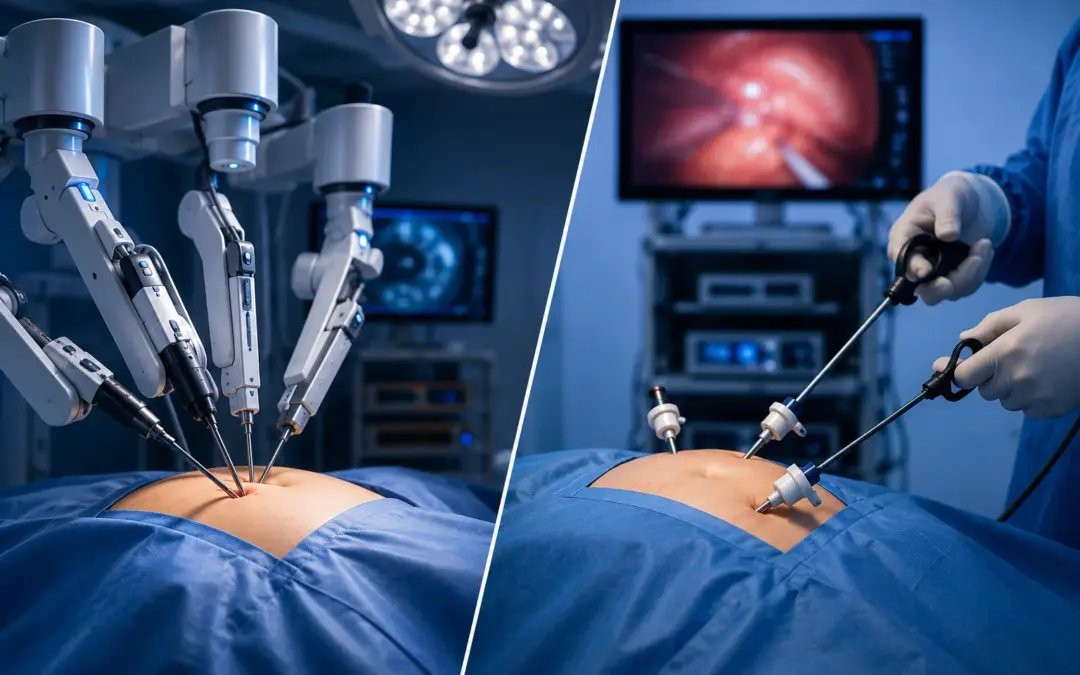
Both are keyhole procedures, and both are considered safe for a hernia that has come back. Laparoscopic repair is usually quicker and lighter on cost. The robotic approach brings a magnified 3D view and finer instrument control, an edge that starts to matter once scar tissue from an earlier repair narrows the working space. Tight scarring changes the calculus.
According to Dr. Surendra Jasti, a Robotic and Laparoscopic Surgeon in Vijayawada, “For a first-time hernia, laparoscopic repair serves most patients well. Once a hernia recurs, the tissue is scarred and less predictable, and that is where the robotic platform’s steadier visualization and articulated instruments prove their value.”
Not sure whether your recurrent hernia calls for a robotic repair or a standard laparoscopic one?
How do the two approaches actually differ?
Both use small incisions and mesh to close the defect. Same goal, different tools.
Aspect | Robotic Repair | Laparoscopic Repair |
Visualization | Magnified 3D view of the repair site, useful when old scarring has blurred the usual landmarks | Standard 2D view |
Cost & Speed | Costs more, needs console setup | Runs faster on the table, costs less |
Instrument Reach | Moves more like a human wrist, easier for precise mesh placement in a tight or scarred pocket | Straight instruments, less flexible reach |
Role of Experience | Steeper learning curve, so surgeon experience counts for more than patients often expect | Outcomes still lean on experience, but the curve is gentler |
Either approach can close a recurrent hernia well in the right hands. So the right choice depends less on the technology and more on the surgeon holding it. Our hernia treatment in Vijayawada covers both options in more detail, including how mesh type and hernia location shape that choice.
When does robotic repair make more sense for a recurrence?
Recurrence isn’t one problem. The right approach depends on what the first surgery left behind.
Multiple Prior Repairs: Layers of old mesh and scar tissue are easier to navigate with the robot’s finer control.
Dense Scar Tissue: Heavily scarred planes resist safe separation with standard tools, and robotic dissection tends to cope better here.
Tight Mesh Placement: Fitting new mesh around existing hardware requires a steadier, more precise reach.
Awkward Anatomy: Corners near old incisions or the groin are easier to reach with wristed instruments than straight laparoscopic ones. Because the angle matters as much as the tool.
It’s worth noting that not every hospital in Vijayawada even offers the robotic option, so availability alone often settles the question before preference gets a say.
Whichever repair fits your case, recurrence surgery usually needs a slightly longer settling-in period than a first-time repair. Our hernia recovery guide walks through what that stretch typically looks like, week by week.
Why choose Dr. Surendra Jasti for recurrent hernia repair?
Dr. Surendra Jasti brings over 26 years in general and gastrointestinal surgery and more than 13,000 procedures to that judgment call, with training that spans an MS in General Surgery and an MCh in Surgical Gastroenterology, alongside recognised membership with bodies including IAGES and ARSI.
Recurrent hernia surgery carries a different level of risk than a first repair, and that difference is where experience matters most. For a hernia that has already come back once, that experience translates into a considered recommendation: robotic where the anatomy genuinely calls for it, laparoscopic where it doesn’t, rather than a default to whichever technology happens to be newest.
Frequently Asked Questions
Is robotic repair better than laparoscopic for a recurrent hernia?
Not universally. It tends to help most in cases with dense scarring or multiple prior repairs, where the added visualization and reach genuinely make a difference.
Does robotic hernia repair cost more?
Generally, yes. The additional equipment and console time typically add to the overall cost compared with a standard laparoscopic repair.
Is recovery different between the two approaches?
Recovery is broadly similar for straightforward cases. For complex recurrences, the deciding factor is usually how much scar tissue was involved, not which tool was used.
Can every recurrent hernia be repaired robotically?
No. Availability, the patient’s overall fitness for surgery, and the specific anatomy all factor into whether a robotic approach is appropriate.
References
1. NIDDK (NIH) – Inguinal Hernia → https://www.niddk.nih.gov/health-information/digestive-diseases/inguinal-hernia
2. SAGES – Patient Information for Laparoscopic Ventral Hernia Repair → https://www.sages.org/publications/patient-information/patient-information-for-laparoscopic-ventral-hernia-repair-from-sages/
Disclaimer
This blog is for general informational and educational purposes only and is not a substitute for professional medical advice, diagnosis, or treatment. Always consult a qualified doctor or surgeon regarding your specific condition.