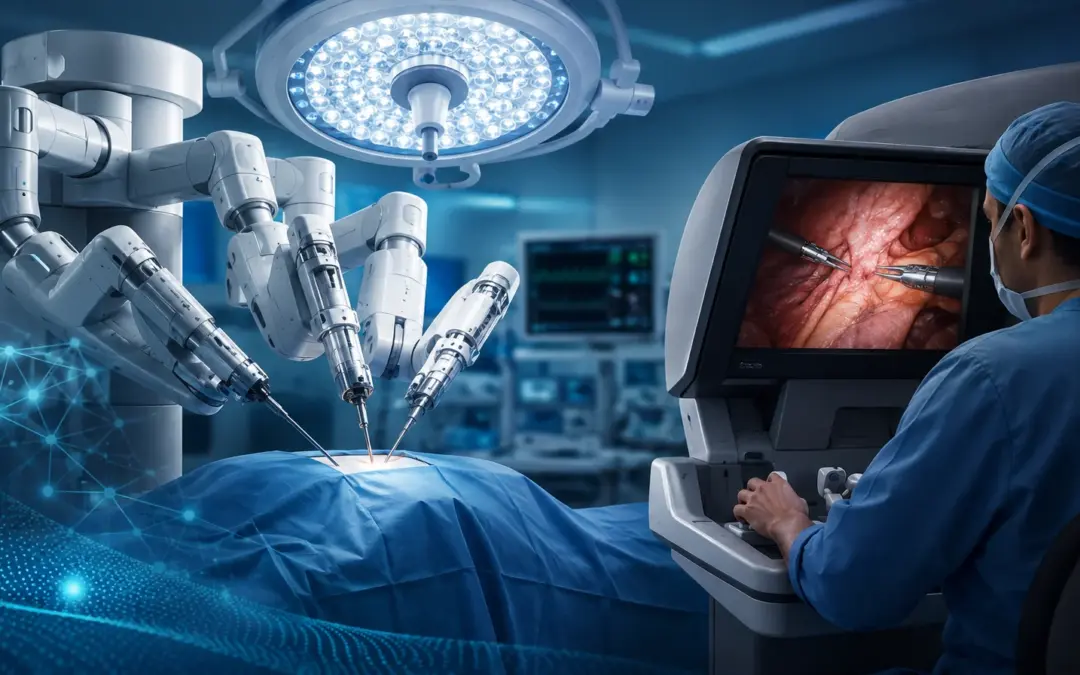
The robot doesn’t operate on its own. A surgeon sits at a console a few feet from the patient and guides small robotic arms holding the actual instruments, and every hand, wrist, and finger movement gets mirrored onto those arms in real time. Steadier and finer than what a human hand alone could manage inside a small incision.
According to Dr. Surendra Jasti, a Robotic Surgeon in Vijayawada, “Patients often picture something autonomous, almost like a machine making its own decisions. It isn’t that. I’m making every cut and every stitch. The system just lets me do it with a steadier hand and a much better view than I’d have standing over the patient directly.”
Curious whether robotic surgery is the right fit for your condition?
How does the robotic system actually work?
Underneath, it’s still surgery in every sense that matters. What changes is the instrument placed in the surgeon’s hand.
Console Control: The surgeon sits at a console nearby and views the surgical site on a magnified screen instead of looking straight into the incision.
Wristed Instruments: These instrument tips rotate and bend far more than a straight laparoscopic tool ever could, closer to how a human wrist moves.
3D Magnified View: Depth perception improves noticeably compared to a standard laparoscopic camera, thanks to the high-definition 3D feed.
Real-Time Translation: Nothing gets delayed. Every hand movement at the console gets scaled down and mirrored on the instruments inside the body, filtering out natural tremor along the way.
None of this replaces the surgeon’s judgment. But it sharpens the execution, and that’s really the whole point of the system. Our gallbladder treatment page shows one procedure where that sharper execution shows up clearly, especially in cases with tricky anatomy.
Where is robotic surgery actually used?
Not every operation needs one. Plenty still benefit.
Gallbladder Removal: Helps in cases with unusual anatomy or a history of prior abdominal surgery.
Hernia Repair: Especially useful for a recurrence, where old scar tissue narrows the working space.
Bariatric Procedures: Assists with suturing and stapling in high-BMI patients, where visibility is naturally more limited.
Complex GI Surgery: Deep or tight anatomical spaces tend to benefit most from the added dexterity.
It’s worth saying that not every hospital in Vijayawada offers this option yet, so access alone often decides the question before preference even comes up.
So the honest answer is: it depends on the case, not the condition alone. We covered this trade-off in more depth in our robotic vs laparoscopic comparison for recurrent hernias, if you’d like to see how the decision actually plays out for one procedure.
Why choose Dr. Surendra Jasti for robotic surgery?
Dr. Surendra Jasti brings over 26 years in general and gastrointestinal surgery and more than 13,000 procedures to that judgment call, with training that spans an MS in General Surgery and an MCh in Surgical Gastroenterology, alongside recognised membership with bodies including IAGES and ARSI.
Robotic surgery is only as good as the person holding the controls. A new platform doesn’t shortcut years of open and laparoscopic experience. It builds on top of it, and that’s the order it should happen in. No shortcuts here.
Frequently Asked Questions
Is the robot doing the surgery on its own?
Not at all. The doctor makes every cut and places every stitch, from start to finish. The console just lets him do it with steadier hands and a much closer view.
Is robotic surgery safer than laparoscopic surgery?
Safer isn’t quite the right word for it. What it gives you is a clearer view and finer control, and that matters most when the anatomy is scarred or hard to reach. For a straightforward case, laparoscopic does the job just as well.
Does robotic surgery hurt less than open surgery?
Usually. Small incisions mean far less trauma to the abdominal wall than a large open cut, so pain stays lower and patients are back on their feet sooner.
Is robotic surgery available for every procedure?
No, and honestly, that’s often about access more than suitability. Not every hospital has the equipment or a surgeon trained on the console, so availability tends to settle the question before anatomy even gets a say.
References
- NIDDK (NIH) – Treatment for Gallstones → https://www.niddk.nih.gov/health-information/digestive-diseases/gallstones/treatment
- MedlinePlus (NIH) – Ursodiol → https://medlineplus.gov/druginfo/meds/a699047.html
Disclaimer
This blog is for general informational and educational purposes only and is not a substitute for professional medical advice, diagnosis, or treatment. Always consult a qualified doctor or surgeon regarding your specific condition.